

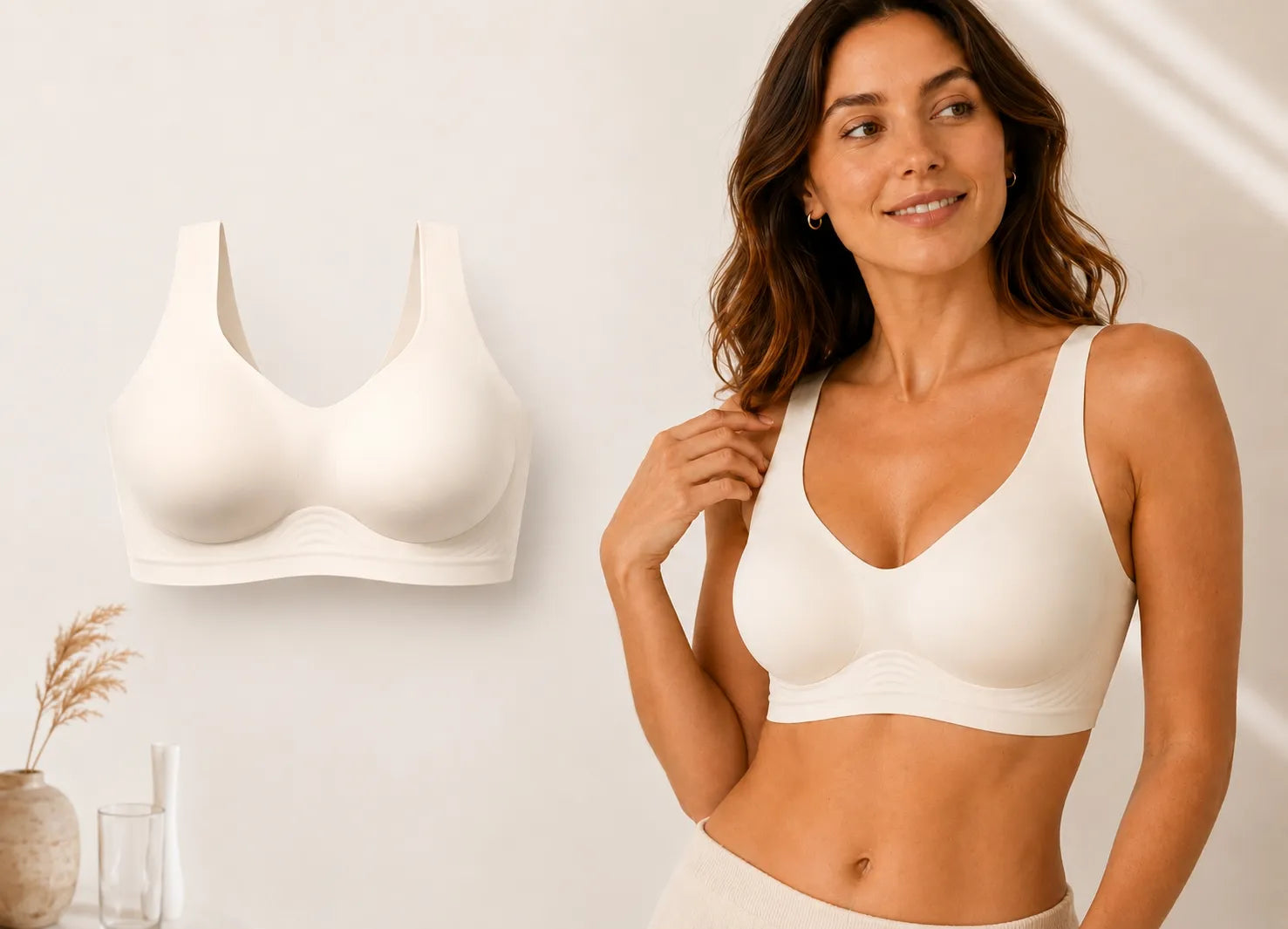
Close-set breasts have little space between their inner roots. A wide or tall bra center can sit on breast tissue instead of the chest, causing pressure, rubbing or a center that refuses to lie comfortably. The solution is usually not a larger band. It is a center shape that respects the space you actually have.

Breast spacing is only one part of shape. You can be close-set with a small or large bust, firm or soft tissue, and centered or outward-pointing nipples. Identify the root spacing first; then choose support and cup depth.
What are close-set breasts?
Stand naturally without a bra and look at where each breast attaches near the center of the chest. If the inner roots sit close together with little flat space between them, your breasts are likely close-set. They may touch at the center, but touching is not required.
Do not use a strict “one-finger” rule as a diagnosis. Breast roots curve, tissue moves and finger width varies. The more useful clue is how bras behave: wide center panels consistently press on tissue, while low or narrow centers feel noticeably easier.
The Soft Intention breast shape guide can help you look at fullness, projection and direction alongside spacing.
Close-set vs. centered vs. touching breasts
|
Term
|
What it describes
|
What to observe
|
|
Close-set
|
Small space between the inner breast roots
|
Center panels often feel too wide
|
|
Centered
|
Nipples or fullness generally face forward
|
Direction, not root spacing
|
|
Touching
|
Breast tissue meets at the center in a natural stance
|
Can occur with close roots, high volume or both
|
A woman can have centered nipples and still be close-set. She can also have close-set roots with nipples that point slightly outward. This is why nipple direction alone does not determine the best bra.
Why wide center gores can be uncomfortable

In a wired bra, the center gore is the fabric panel and wire ends between the cups. If it is wider than the available chest space, the wire may land on inner breast tissue. Tightening the band can make that pressure worse.
Wireless bras do not have hard wire ends, but a broad, stiff center can still compress or fold. A softer V-shaped bridge often adapts better because it becomes narrower as it rises. A low plunge center leaves more room but may provide less upper containment for very soft or center-full tissue.
The goal is not always a perfectly flat center. In wireless construction, the bridge may sit differently than a structured underwire. Comfort, containment and stability matter more than copying one fitting rule from another bra type.
Best bra features and styles
Narrow or low center: A plunge, V-neck or narrow bridge uses less space between the cups.
Soft wireless center: Flexible fabric avoids two rigid wire tips pressing into close roots.
Adequate cup depth: A shallow cup pushes tissue toward the center and can create spillover even when the center width is suitable.
Side support: Guiding tissue forward can improve shape without forcing the breasts together.
Flexible neckline: A smooth stretch edge follows the upper cup without cutting into center fullness.
Adjustable band and straps: Fine-tuning helps hold the cup in the correct position instead of letting it drift inward.
For wired styles, look for a genuinely narrow, low gore and make sure every part of the wire sits around—not on—breast tissue.
Styles that may be harder to fit
High full-cup bras with a tall, wide center may press at the inner roots. Balconette bras can work, but many place both the gore and straps wide. Very shallow molded cups may push tissue toward the neckline, creating center spill even when the marked size seems correct.
Strong push-up padding can also crowd an already close center. If you want lift, look for support from beneath and the sides rather than thick inner pads. A compression-style bralette may flatten the bust into one area instead of giving each side enough cup room.
None of these styles is universally wrong. The problem is a particular width, height or depth meeting your individual shape.
Try-on checklist
- Set the band level on the loosest comfortable closure.
- Place the lower cup directly beneath each breast.
- Scoop tissue from the underarm and center it in the cups.
- Check that the center does not sit on or pinch inner tissue.
- Confirm the neckline contains center fullness without cutting in.
- Raise your arms and lean forward; the breasts should remain separated and contained.
- Wear a V-neck top over the bra to confirm both support and coverage work with your wardrobe.
If the cups overflow but the center feels fine, you probably need more cup volume or depth—not a wider center. If the band rides up, correct the anchor before judging the bridge.
Soft Intention product options

V-Neck Jelly Wireless Bra with Back Clasp
The V-Neck Jelly Wireless Bra uses a low, narrow V center with flexible wireless support and an adjustable back clasp. It is available from S to 3XL in six listed colors.
Best for: A lower everyday center with fine-tuned band adjustment.
Watch for: The current size range ends at 3XL.
Plus Size V-Neck Wireless Bra
The Plus Size V-Neck Wireless Bra extends from M to 6XL. Its V center leaves less material between the breasts than a high full-coverage bridge.
Best for: Women who need 4XL–6XL and wear open necklines.
Watch for: Check upper containment if your tissue is very soft or center-full.
Full-Coverage W-Shaped Jelly Wireless Bra
The W-Shaped Jelly Wireless Bra combines a V neckline with full coverage and flexible support in S–3XL.
Best for: Close-set breasts that also need more lower-cup structure.
Watch for: Make sure the V seam remains between, not on, inner tissue.
Related shape questions
Close-set describes inner-root spacing. East-West describes outward direction, and wide-set describes more chest space between the roots. Those traits can overlap in unexpected ways. The existing East-West breast shape guide explains direction, while the broader breast-shape guide helps identify other traits.
Choose the center that fits your body, then judge cup depth and support. A narrow V-neck bra that stays comfortable through sitting and movement is a better match than a “perfectly tacking” center that presses all day.
Share:
Best Bras for Hot Weather and Boob Sweat
Asymmetrical Breasts: Bra Fit Fixes That Don’t Overcorrect