

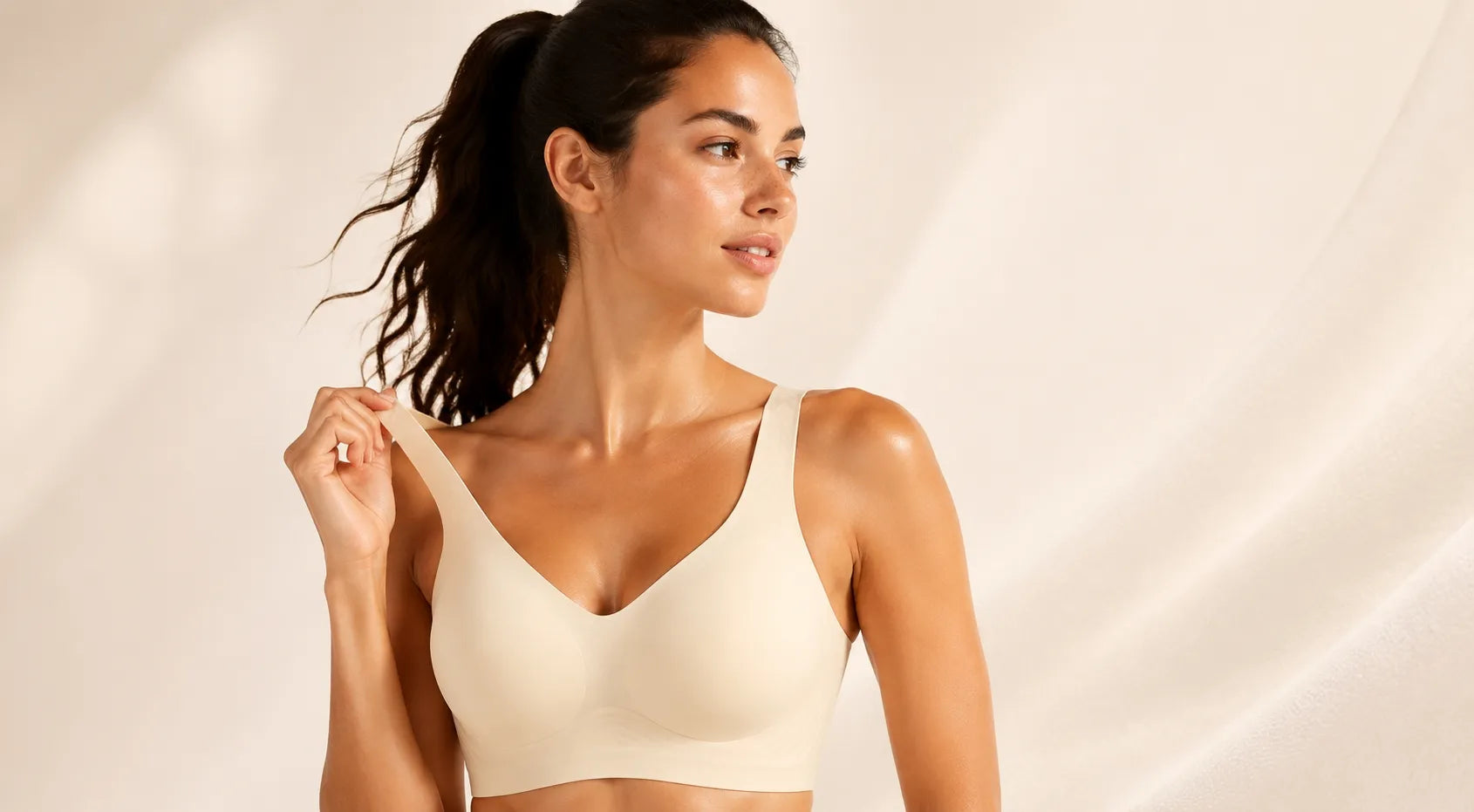
The short answer: a jelly bra replaces a rigid underwire with flexible gel-like support, while “regular bra” can describe several very different constructions. Some regular bras are wired and padded; others are wireless, unlined or made with airy spacer foam. So the useful question is not whether one category always wins. It is which construction gives you the support, temperature, shape and freedom you want on a particular day.

This guide compares a Soft Intention Jelly Bra with the most common everyday alternatives without pretending that every conventional bra feels the same.
Jelly bra vs regular bra at a glance
|
Feature
|
Jelly bra
|
Structured underwire bra
|
Wireless foam or unlined bra
|
|
Support frame
|
Flexible Jelly Gel® structure
|
Rigid metal or plastic wire
|
Fabric, seams, foam and band
|
|
Lift
|
Natural, flexible lift
|
More defined lift and separation
|
Varies widely by construction
|
|
Pressure feel
|
Broader, softer contact
|
Firmer line beneath the bust
|
Usually soft, but the band may compensate
|
|
Movement
|
Designed to flex with the body
|
Holds a more fixed cup shape
|
Flexible; may offer less containment
|
|
Under-clothing look
|
Often seamless and smooth
|
Smooth if molded; seams may show
|
Depends on cup and edge finish
|
|
Best fit for
|
Long everyday wear and wire-free support
|
Precise shaping and structured necklines
|
Lounging, light support or simple daily wear
|
If your priority is seamless everyday coverage, the Jelly Wireless T-Shirt Bra, S–6XL is the clearest starting point. It is designed with wireless Jelly support, full-coverage cups and a smooth surface for tees and fitted tops.

Official product reference: Seamless Underwire Effortless Shaping Lift Balconette Bra.
What does “regular bra” include?
“Regular” is a shopping label, not a technical specification. Before comparing, identify what is actually inside the bra.
-
Molded foam bras use pre-shaped cups for coverage and a rounded outline. They may be wired or wireless.
-
Spacer bras use a lightweight knitted cup material with tiny air spaces. They aim for a smoother look with less bulk than dense foam.
-
Unlined bras create shape through seams, fabric tension and sometimes underwire. They can feel lighter but may show cup seams under thin clothing.
-
Underwire bras use a rigid curved wire beneath each breast. Cup material can be foam, mesh, lace or unlined fabric.
-
Wireless bras rely on the band, cup structure, wings and straps. A jelly bra belongs to this broad category, but adds a flexible reinforcement system.
That is why blanket claims such as “regular bras are hot” or “wireless bras cannot lift” are unreliable. The complete design matters more than a single label.
Support and lift

An underwire creates a firm boundary below and around the breast. In the correct size, it can deliver strong anchoring, separation and a clearly defined silhouette. In the wrong size, that same wire may sit on tissue, poke at the underarm or slide down the ribcage.
A jelly bra takes a softer approach. The band anchors the garment while the flexible Jelly Gel® structure helps guide the bust upward and inward. The cup controls the final shape. The lift generally looks natural rather than sharply projected, and the support flexes as you move.
For more lift with wireless comfort, the Full-Coverage Push-Up Jelly Wireless Bra is designed around that trade-off. Its published size range is S–3XL, so shoppers who need 4XL–6XL should choose one of the extended-size styles instead of assuming every Jelly Bra shares the same range.
Comfort and pressure points
Comfort is personal, but pressure usually becomes uncomfortable when it is concentrated in the wrong place. Common examples include a narrow wire at the ribs, a band that is too tight, a cup edge cutting into breast tissue or straps carrying more weight than they should.
The flexible frame and seamless edges of a jelly bra are intended to reduce hard contact points. This can be especially welcome during long workdays or for women whose skin has become more sensitive over time. It is not permission to ignore fit. A too-small jelly bra can still compress, roll and chafe; a too-large one can shift and rub.
If you see overflow at the neckline or underarm, read our guide to bra spillage and how to fix it before tightening the straps again.
Heat, sweat and breathability
Neither “jelly” nor “regular” tells you exactly how cool a bra will feel. Heat and moisture depend on cup thickness, fabric structure, lining, coverage and how closely the bra fits. A thin unlined underwire can feel cooler than a thick wireless molded bra. Conversely, a lightweight seamless jelly style may feel less restrictive than a heavily padded conventional bra.
Women dealing with summer heat or hot flashes should look for purposeful ventilation and lighter construction. The Summer Jelly Wireless T-Shirt Bra is described as breathable and lightweight, while the Cooling Airflow Full-Coverage Bra adds visible airflow vents and extends from M to 6XL.
No bra prevents sweat or treats an under-bust rash. Change out of damp fabric, wash regularly and speak with a clinician if irritation persists.
Shape retention and durability
Underwire is rigid, but rigidity does not guarantee a longer-lasting bra. Wires can bend or work through the channel; molded foam can crease; bonded edges can separate; and elastic bands eventually relax. A jelly bra also experiences material fatigue as its flexible support and stretch fabrics repeatedly bend and recover.
Care makes the biggest practical difference. Rotate bras instead of wearing one every day. Hand wash in cool water, avoid wringing and high dryer heat, reshape the cups and air-dry. Replace any style when the band no longer anchors, the cups remain distorted or the support feels noticeably different.
Soft Intention does not publish matched-cycle durability tests across its Jelly, foam and underwire products, so an exact “lasts X times longer” claim would be misleading.
Best choice by bust size, outfit and wearing time
For a fuller bust, start with engineering rather than the wireless-versus-wired debate. Look for a level, secure band; enough cup depth; full side containment; straps that stay comfortable; and a cup edge that does not cut in. The Plus Size Bra collection makes it easier to compare styles that extend beyond the common 3XL ceiling.
For a fitted T-shirt, smooth molded or seamless cups are usually the easiest choice. For a low square or balconette neckline, a structured underwire bra may stay hidden more effectively. For travel, desk work or an all-day event, flexible Jelly support may be the more comfortable compromise. For high-impact exercise, use a sports bra designed for that movement.
Color also matters under light clothing. “Nude” is not one universal shade. The core Jelly Wireless T-Shirt Bra currently offers a range that includes Beige, Caramel, Pink Nude, Dark Nude and Light Nude, along with classic and accent colors. Use the shade closest to your skin rather than automatically choosing white beneath a white top; our guide to the best bra colors under a white shirt explains why.
Verdict: which trade-off fits you?
Choose a jelly bra when you want flexible, wire-free support, smooth coverage and a natural shape for long daily wear. Choose a structured underwire when you want more defined separation, a specific neckline or firmer shaping. Choose a light unlined or spacer bra when low bulk and airflow matter most, provided it gives you enough containment.
The best bra is not the one with the strongest claim on the label. It is the one that stays level, contains your bust, moves without rubbing and still feels good several hours later. Take fresh measurements with the Soft Intention bra size calculator, then compare the styles in the Jelly Bra collection according to the way you actually plan to wear them.
Share:
Jelly Bra vs Memory Foam Bra: What’s the Difference?
Best Wireless Bras for Large Breasts, Ranked